This post is a little out of the ordinary but is important because it concerns the readers and, especially, the commentors on this blog. I do very much appreciate the comments which are made as they often give me new ideas to try as well as provide some pleasure knowing that the blog is being enjoyed.
Recently, however, there have been some questions asked and, when I try to reply on the blog, cannot do so. I have diligently searched to find the cause of this problem and have yet to find it. Just to make sure that no one thinks I am ignoring him, I will answer a couple of the questions right now.
From Rene Gourley who showed some skepticism on painting stock cars green, I say:
It was an educated guess. Prototype photos show a dark color which could be red or green. I have enough BCR cars on the railroad so I chose green. I also have original specs for another car which does indicate green with vermilion ends so I guess that green is an appropriate, if not practical, color.
And to Gregory Rich who wondered where Pittsburg, California is located.
Pittsburg is on the San Joaquin River just east of its junction with the Sacramento River. It was a coal-mining town initially called Black Diamond (among a few other names). The original lettering on the car was for Waverly Oil in Pittsburgh PA but my friend changed it to California since there was a similarly-named city. He did the revisions and the original model so I cannot claim any credit except that of being a happy recipient.
If anyone has any suggestions on how to solve my Reply issues, I would appreciate hearing it. You can email me at dlball1899@gmail.com. Thanks for reading.
Don

Saturday, January 27, 2018
Saturday, January 20, 2018
New Shipper on the S&C
 |
| The Waverly Oil tank car sits on a siding in Oakdale awaiting transport to the to-be-developed oil loading facility at Waverly. |
At least that's the way the newspaper should have published the "event." In reality John Breau, one of the S&C operators, produced a tank car today that he had built over 40 years ago from a La Belle kit. Since he models the early 1950s, he had no use for an older prototype car so he refurbished it and gave it to me. You can see that it is lettered for the Waverly Oil Company based in Pittsburg, California. Since Waverly is a siding on the railroad, I naturally assumed that someone had struck oil in its vicinity.
For those not familiar with California geography, Pittsburg is a town on the San Joaquin River and could very well have been offices for an oil company. At that date, the routing of the car is unknown [i.e. the car card and waybill have to be printed]. Of course, this also means that I have to build some way of loading the tank car but Waverly still needs a grain warehouse anyway so locating a tank car platform should not be a problem.
Thanks to John for adding an interesting car to the railroad.
Wednesday, January 3, 2018
Horseless Carriages Invade Burnett's
 |
| Two Locomobiles on the main street of Burneett's. The green and blue colors, among others, were factory options. I picked those since they matched the color of my Locomobile and that of a friend's. |
 |
| Powered by steam, the boiler of these cars is under the seat along with the engine. The rear of the car contains the water tank. You can see the tufted upholstery on the left-hand car. |
The bodies of the two cars were made using 3D printing. I worked up a drawing in Sketchup and then sent it to Shapeways to do the actual printing. There are three parts: the body, the chassis and the tires. When I received the parts from Shapeways, I still had to fabricate springs, the tiller and other small parts. Photo-etching enabled me to produce the wheel spokes which fit into a groove in the tires.
 |
| On the workbench before being placed on the railroad. |
Upholstering the car was little more difficult. The prototype used leather in a tufted pattern. Not having any wish to actually use fabric, I substituted a piece of styrene and scribed it where the folds would fall. A small drill was used at each intersection to make a small dimple which would represented the buttons.
 |
| The author's 1901 Locomobile. Note that the tiller is now on the side of the car rather than the center. This was an improvement in 1901 as was the ability of the brakes to work when going backward. |
Tuesday, December 12, 2017
Another Private Owner Stock Car
 |
| Canda Cattle Car Company car 78 sits on the siding at the Burnett's stock pen. The hatches on the roof access feed for the occupants while the hand wheels control partitions between the cows. The center hatch is for the water supply which is distributed by the piping along the edge of the roof. |
The car itself was 39 feet long and carried feed and water for the cattle so that stops for these items were reduced. In addition, partitions were provided between every cow or two to prevent them from injuring each other (or piling up at one end during an emergency stop). These partitions were controlled by the handwheels along the roof. Less than 200 of these cars were built as, by 1890, about 1800 of the type II car featured in my former blog post were in use.
The model was built entirely of styrene in a jig to get the side slats reasonably straight. The trucks are Canda style trucks made by Bitter Creek Models and are very nice-looking. The numerous hatches on the roof all have hinges which are prominent. I had some 3D printed and they turned out nicely. The hand ring lifts on the hatches were made from Detail Associates lift rings.
I still need a couple of models from Streets Western Stable Car Company and the Hicks Stock Car Company.
Wednesday, November 15, 2017
Coal Gondolas on the Stockton & Ione
 |
| Ten new coal gondolas sit on tracks next to the storage bins of the mine. The mine structure was salvaged from my former layout and will eventually be incorporated into the railroad. |
The finish on the cars are a little rough but this works on cars which are supposed to have been beat up due to the load they were carrying. The weight is a little low but there is not much room for more weight anywhere. I am still working on that problem.
Thursday, November 2, 2017
Little John Creek Bridged!
 |
| The bridge at Little John Creek is supported by stone abutments with the scenery roughed in around the bridge. |

The prototype columns were constructed with four pieces of cast iron, each formed in a quarter circle. Flanges were then riveted together to form a hollow tube. I ended up by using a styrene tube with .020x.020 styrene strips glued around it. With the size of the tube and the distance from the viewer, you just don't see whether or not there are rivets. The rest of the bridge was constructed with other strips and shapes of styrene. To build something similar, see Jim Vail's article in the May/June 2001 Narrow Gauge and Short Line Gazette. I used Jim's article plus drawings for a similar bridge in the California State Railroad Museum.

The bottom part was eventually glued to styrene bridge shoes and to the abutments. The plywood temporary bridge was then cut out beneath the track and the roadbed and ties removed so all that was left were the rails. The rails were then coated with Barge cement on their undersides. Wooden wedges made from construction shims were coated with white glue and slide under the abutments gradually lifting them until the rails just touched the bridge ties. They were left to dry and then a small heated iron was used on the rails to melt and the glue and bond the rails to the ties.
 |
| The abutments are in place with the bottom part of the bridge lying in place beneath the rails. |
 |
| Glue-coated wedges allowed the abutments to gradually be slipped beneath the rails. The excess parts of the strips were sawn off after the glue dried. |
Thursday, October 19, 2017
Conventions and Operations
 |
| Americans and ten-wheelers, all made from 3D printed materials abounded at the American Civil War Railroads convention. Drivers were from the Mantua/Tyco General or imported from Great Britain. |
WV 1866 roundhouse was also made.
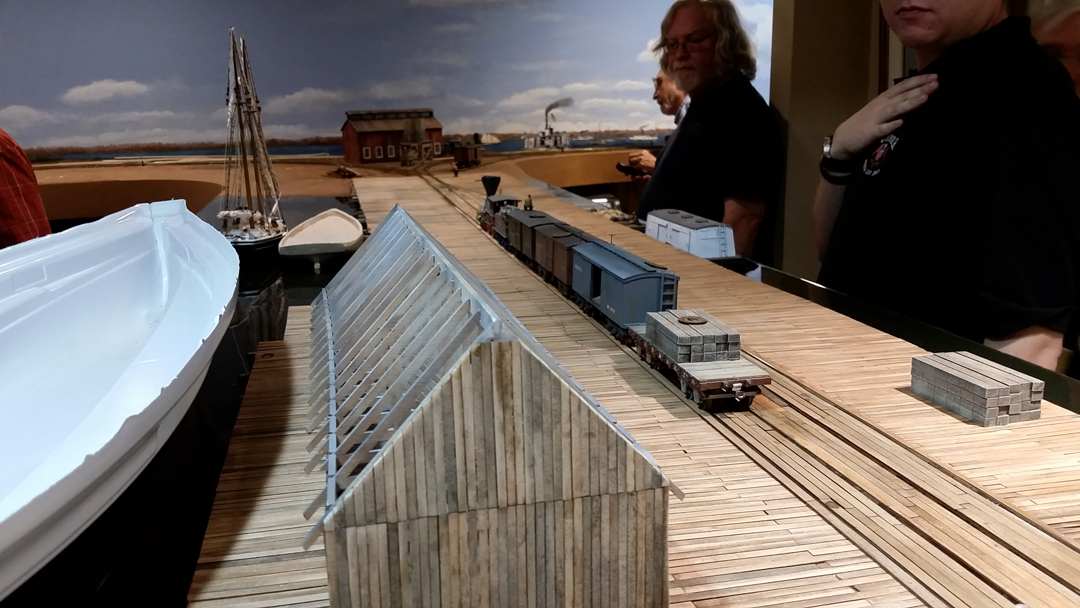 |
| A supply train at the Aquia Landing pier is ready to depart for Falmouth on Bernie Kempenski's U.S. Military Railroad. The white shape on the left is a hull of what will eventually become a side-wheeled supply ship. |
 |
| The yard at Falmouth is the site of much switching The small disks on the car tops contain the car's destination and if it is loaded or empty. |
Unfortunately, these great get-togethers only come once per year but it makes me look forward to the next one. Now, back to modeling.
Subscribe to:
Posts (Atom)