Wednesday, May 3, 2023

The Stockton & Copperopolis still runs but selling excess stock.

 Don's Stockton & Copperopolis was operated during the recent ProRail here in Kansas City Metro. If it hadn't been for all the hard work of Keith, Mark, Ray and Jeff, it would not have been operational. It had not been run since October, and layouts need to be run often. Thanks for all your hard work.

Nothing is being sold from the layout, but if you are interested in a specific item, email me and I will put you on the list I'm compiling of requests.

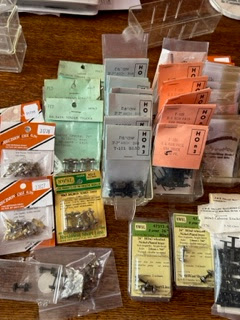
I'm trying to put together like items and listing them for sale here and on some of Don's io.groups.  I would like to sell this box as one lot.

HOn3 Items - Everything (except brass locomotives) that says HOn3.

 I grouped like items and here are the pictures of what you would be purchasing.


  • If you are interested in them, you can leave a comment or go to groups.io/g/EarlyRailSale. I'm asking $170 for the entire lot. I will ship most economical. 
  • I have an Lot HOn3 excel spreadsheet if you need more information.
I hope this works - send Don's email a message if you are having problems. DLBall1899@gmail.com.

Thanks for looking, and yes, I still miss him every day and night.

Becky Ball, 

Monday, December 13, 2021

Another Saloon ???

 
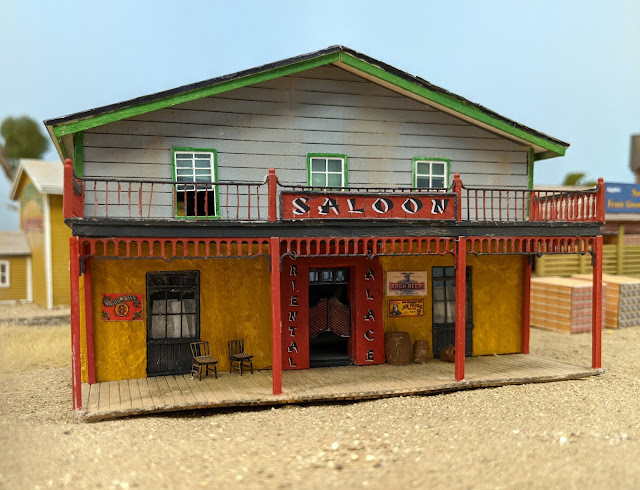
The Oriental Palace in a temporary location in Farmington. Its final resting place is to be determined.

It seems that saloons are all that is being constructed on the S&C Railroad. Well, the nineteenth century was known for having a copious number of such establishments in every town. This particular one was built for a couple of reasons. The first was to try out my skills for designing and then assembling my own laser-cut "kit." The second was to try and duplicate a nice structure I saw while watching the movie The War Wagon. 
     The building itself is interesting to me because of the adobe first story surmounted by a frame second story. Also, the suggestion that it is run by a Chinese person indicated by the red and black paint scheme and the faintly oriental style decorations. 
    To design the building, I drew it up to scale in Adobe Illustrator, then included the tabs and notches which make laser kits go together so easily. The windows, frames and balcony decorations were all done in Illustrator as well. The basic wall structure is made from 1/16" thick basswood with the wood siding burnt in by the laser. The Adobe look was made by stippling on some Scale Stucco as supplied by Crescent Creek Models (https://thundermesa.studio/product/scale-stucco-all-scales/). This was then painted a fairly revolting color which proves the proprietor has no aesthetic taste. The windows were also cut on the laser with what I thought was a good result for the window muntins. These are made in three pieces (upper sash, lower sash and frame) so that they can be positioned in an opened or closed position.
     The balcony railing shows a little wear probably resulting from a scuffle on the second floor. I wanted a somewhat seedy establishment and I think I accomplished that.

Wednesday, November 24, 2021

Saturday Night at the California Grand Palace

In my August 21 post (http://sandcrr.blogspot.com/2021/08/finally-done.html), I described the installation of the finished California Grand Palace and showed a few photographs. Since then, I have make a  video which does a bit better in displaying the details of the structure. The sound track in the video is the same as the one used in the finished saloon. I hope you enjoy "Saturday Night at the Grand Palace."


Friday, September 24, 2021

Yet Another Inspection Locomotive


Inspection Locomotive Number 300 leaving the Stanislaus River bridge and carrying the superintendent to Oakdale.

Inspection locomotives are one of my weaknesses. My last such engine was reported on almost one year ago (http://sandcrr.blogspot.com/2020/12/another-inspection-engine.html). This engine is similar to the previous one in that it is a brass model of the Lehigh Valley's Dorothy. The main difference between this one and the previous loco is this engine represents an earlier version of the locomotive.
   

 Red Ball imported this piece in the 1960s-70s in both versions. Since this was the earlier version, I decided to add spoked wheels on the pilot and trailing trucks. A Minebea 15mm can motor with a new NWSL worm was installed along with a Tsunami2-Steam2 decoder. 
     In my research, inspection locos never were used west of the Rockies so these would be hard to find on a California railroad but, it's my railroad and I like them. If you are interested in learning more about these fascinating engines, pick up a copy of Railroad History magazine, issue No. 206. It has a very detailed article by Ron Goldfeder which covers about every inspection engine built. 

Friday, September 3, 2021

Mail and Express Wagons

 
The Wells Fargo Express wagon at the Farmington depot. Noe that the name reads "Wells Fargo and Co's Express." The
plural of "Co." was used on WFCo signage until the company dropped the "'s" in 1898.


I had been wanting for some time to build a small express wagon, the kind with a top but just wire screened sides. I had seen several pictures of such a wagon but there was no kit of one. Jordan had produced such a body but mounted on a 1925 Model T Ford chassis, a bit too new for my needs. Having such a kit at hand gave me the idea of using just the body and making my own wagon underframe. 
     Several months ago, when Jordan ceased production, I had created 3D drawings of their wagon underframe and so I put those on the 3D printer and got  some pieces for my project. Wheels were spares I had from another kit I had assembled. The parts went together easily and so I had the wagon desired. A few decals later and the project was done. Being pleased with the outcome encouraged me to make another wagon, this one for the mail as I had also seen photos of this kind of wagon used in that service.
The U.S. Mail used a similar screened wagon but with a bit fancier lettering scheme.
     In general, I am happy with the outcome, however, the chassis parts are a bit too large having been designed for Jordan's heavier delivery wagons. I think the lighter units made for the light delivery wagon would be much better. To that end, I drew up some more 3D drawings and will have a chance to print those up in the near future.

Saturday, August 21, 2021

Finally Done!

An overall view of the saloon. The side nearest the camera and the roof will be clear acrylic so visitors can see into the structure.

 Some projects seem to last forever. My California Grand Palace saloon was one of these (http://sandcrr.blogspot.com/2021/05/a-work-in-progress.html). There was a lot of different things to do and, after adding in the electronics, a lot MORE things to do. It is now, however, ready to be installed on the railroad.
The pool table offers an interesting distraction to patrons. 
Note the spittoon and it surrounding area of "misses." No 
model spittoons were found so I had mine 3D printed.
     
The bar includes a free lunch counter. Note the beer mugs on
the bar.

As mentioned before, the building is constructed with clear acrylic plastic walls. Evergreen styrene siding is glued to the outside while wallpaper is applied on the inside. In both pieces, cutouts were made for window locations. Using my laser printer simplified this process immensely. The interior was built of styrene with Grandt Line (now San Juan Details) and Tichy trim pieces.
     One of the factors taking a great length of time was the interior detail. There's an awful lot of tables and chairs which had to be assembled and glued down, not to mention the figures. There are 98 of them, all of which had to be painted. Seated figures are a lot harder to come by, it seems, especially ones who are playing cards. I did find enough, though.
A view from the audience's perspective with the ads of local business on the curtain as was the custom in the 1800s.
     Once mounted on the railroad, the saloon will have lights plus a sound track included a featured singing. The curtain will rise and fall when needed.


Saturday, August 7, 2021

A Visitor on the S&C

The Western and Atlantic's General coasts through Farmington.

 Last week, the Stockton & Copperopolis had a nifty new visitor running through town. It was George Bogatiuk's model of the Western & Atlantic's General. As most of you probably know, the General was one of the locomotives which took part in the Andrews Raid of 1862 otherwise known as "The Great Locomotive Chase." George was in town on business and stopped by to show me the locomotive. It ended up running over the railroad from Oakdale to Stockton and back and it is a very nice-running engine. George started with a Bachmann 4-4-0, added new domes, smokestack, headlamp and other modifications to recreate the locomotive's appearance in 1862. Of course, the engine has a Soundtraxx Tsunami2 TSU 1100 decoder in it with a current keeper and it sounds very nice. 
     For those of you who might not know, George works for Soundtraxx and frequently puts on clinics at various model railroad functions such as the Railroad Protoype Modelers' meet in St. Louis last weekend. He has just gotten interested in Civil War-era railroading and the General is a great first locomotive.

Wednesday, July 28, 2021

New Power for the Stockton & Copperopolis (?)

Great Northern 363 ABC crosses the Stanislaus River bridge during a test run following decoder programming.

The Stockton & Copperopolis is modernizing its motive power fleet with the acquisition of a used Great Northern ABA set? Is the S&C updating to the early 1950s? No, not really. A friend of mine who models the GN was over today and we were working on the programming of a new decoder in his locomotive. After the programming, we took the engine for a spin around the railroad to test it out. John Breau, the locomotive's owner, has a great GN-based railroad upon which I am privileged to operate now and then. The locomotive just looked so good, the company photographer had to record the event.

Friday, May 7, 2021

A Work in Progress

The California Grand Palace's streetside view and main entrance.

The Oakdale trackside area has had a blank spot in it for far too long. Part of the reason it stayed vacant is because I had not yet decided what might go well in that spot. Several weeks ago, I finally reached a decision had began building a suitable structure. I wanted a large saloon with a detailed interior including a stage for entertainers. This saloon would also include a sound track. As of this point, I have completed the exterior structure of the building but the sound and detailing the interior still needs to be accomplished.


The Long Bar is ready for customers but standup ones only. Tables and chairs are still to be added. The stage curtain is typical of early theaters which put the advertising space to good use. The "kerosene" lamps were made from plastic beads and very small leds. 

The saloon is totally freelanced and not based on any specific structure. To be honest, real saloons were generally  built with a narrow front entrance but a long depth, just enough for the bar and a few tables. The Grand Palace has more in common with the huge edifices often seen in Hollywood western movies. It's not particularly prototypical but it is what I was looking for.

    Construction is with acrylic sides with styrene siding laminated to them. The window and door casings were cut using my laser cutter. Other parts were styrene shapes plus detail parts from Tichy and San Juan Details.

     The interior of the building has a stage with a working curtain and a number of LED lights. There's much more to do but the drinking class of Oakdale seem to be looking forward to completion. 

Saturday, April 3, 2021

The Cemetery at Milton


Funerary services are being held for one of the citizens of Milton. All of the items used in the scene are commercial products readily available.

Wandering through the cemetery at Milton (the prototype, not the model) is an interesting look at the past. Some people died young while others lived into their 80s. It seemed appropriate to provide a cemetery for my model Milton. I was able to put together a small cemetery which was not kept up real well but was still serviceable. The mourners, casket and minister came from a Langley (British) figure set while the tombstones were from Woodland Scenics. The fancy fencing is made by Tichy. The sign over the entrance was cut out using my laser cutter. The hearse is a Jordan product.


Wednesday, March 31, 2021

Fifty Years and Counting


While I know I've been in the model railroading hobby for quite a while, it was a surprise to receive a certificate documenting that fact. That would be mean that I joined the NMRA in 1971 which seems about right. Even though I had been reading model railroad magazines throughout my teen years, it wasn't until 1969 when I finally purchased my first car kit and actually moved out of the armchair. After a few kits, I thought it was a good idea to join the NMRA. It's been a fun time and, for me, just the start of more fun with the hobby.


I guess it is fitting that, after 50 years in the Association, it opened its Magic of Scale Model Railroading exhibit at the California State Railroad Museum (as though my tenure in the NMRA had anything to do with that). I found several photos on line showing some of the exhibits in the museum. https://www.flickr.com/photos/192373853@N06/sets/72157718547893733/. It looks like it's well worth a visit if you find yourself in California. I'm not sure when the CSRM will reopen but, hopefully, it will be soon. 


Wednesday, February 10, 2021

New Boxcar Added to Fleet

My Gorre & Daphetid boxcar at Peters. The decals had dimensional lettering for a 36-foot car which is perfect for a Model Die Casting kit and fits right in with my era. 


Every model railroader has a beginning. Mine started in the fifth grade when I discovered that the local library had Model Railroader in its collection. From then until the end of college, my activity in the hobby was limited to reading the magazines. In those days, one of the real treats was admiring the photos of the Gorre & Daphetid Railroad as modeled by John Allen. As most of you probably know, his railroad was then, and still today, a scenic delight. 
      In 1970, I had the opportunity to attend a mini-meet of the Pacific Coast Region of the NMRA in Santa Barbara. Upon my arrival on Friday night, I ran into John in the hotel lobby. We spoke for a while and then, he invited me to join him on the layout tours. I spent the next few hours looking at the area's railroads. Later, he invited me to come up to his hotel room for a discussion of model railroad topics with Cliff Grandt and Charlie Trombley. I mainly listened.
John Allen as I knew him. 
     John was a very nice person and answered my questions and listened to my opinions as though I had years of experience in the hobby. I saw John once again a few months later at another model railroad event. He invited me to come to Monterey to see his railroad. I put off the trip and then, in 1973, John passed away and the railroad was destroyed shortly thereafter.
     Recently, I saw an offering for G&D decals on ebay. On impulse, I purchased a set and applied them to an old Model Die Casting kit. It's not prototypical but model railroading is supposed to be fun and I have a few unprototypical cars on the railroad which remind me of people or moments in my journey in this hobby.
     Every model railroader has a beginning. Fortunately, mine started out with some enthusiasm generated by one of the best modelers in the hobby. 

Monday, January 25, 2021

Railroads, Models and the Quilts They Inspire


 As I have mentioned occasionally on this blog, my wife, Becky, is an ardent quilter. She enjoys her hobby as much as I do mine and is very good at what she does. Over the fifteen years we've been married, I have been the recipient of several quilts she has made. Of those, the best were two railroad-related ones. The latest one, pictured above, is almost finished, lacking only the actual quilting. Becky had discovered this panel and, since it fit my era, bought it for this project. The various blocks surrounding the center image were all made using other images of locomotives of my era. Surrounding the entire project is a set of railroad tracks.
     The second quilt was made on the occasion of our first Christmas in 2001. The images were taken from a website I had about my last railroad, the Moraga Springs Northern. As you can see, the quilting follows the subject of the photo, outlining, locomotives, structures, etc. 
     What do these things have to do with the Stockton & Copperopolis or model railroading? Perhaps nothing but it does have a lot to do with keeping my interest in our hobby alive knowing that I am supported in my endeavors.


Friday, January 8, 2021

Two New Additions

The "Gray house" in its temporary location at Farmington. It will eventually be moved to the residental area.

A few weeks ago, a favor was done for my friend, Doug Taylor. In return, he volunteered to build up an old Classic Miniatures kit I had not gotten to. The Gold Hill House, as the kit is named, is now sitting at Farmington awaiting its final location, adjacent scenicking, etc. Doug substituted styrene for the kit's cardboard siding otherwise it is pretty stock. As usual, Doug did a great job and now it's up to me to follow through. 
     
The disassembled Unimat on the workbench. I am still awaiting a part and drive belts so it can be put back together again.

On the workshop front, I bought a Unimat lathe through ebay with the thought that it might be better for some of the smaller parts that we tend to make in this hobby. The lathe had not been cleaned so it was disassembled, scrubbed and de-rusted. Now it's sitting on my workbench awaiting a part so I can reassemble it and get it working. The Unimat is a versatile machine but only for relatively lightweight projects. I have a 12-inch lather I can use for the bigger stuff. With the small machine, though, I can convert it to a drill press, mill or any number of other things if I find the right conversion kit. It's sort of a miniature Shopsmith. 
     There are slightly larger but more expensive lathes available from Sherline or Micromark but the Unimat has a special appeal for me as I had one in the 1970s. Back then, my interests tended more to the manufacture of antique car fittings so the Unimat was deemed surplus to needs and sold. I wish I hadn't done that but now I can try again.

Wednesday, December 30, 2020

A Look Back

 
The old Forbe's Crossing depot now doing service at Holden on a temporary basis. Maybe a little repair work on the roof would be in order.

     While rumaging around my railroad room the other day, I came across a depot I built back in the 1990s. It really wasn't lost as it was sitting at Holden as a place-holder for the real depot to be built sometime in the indefinite future. Originally, the depot served the community of Forbe's Crossing on my Moraga Springs Northern Railway when I lived in California. I built it from a Period Miniatures kit and then detailed the interior. On that MSN, the structure was right up front and it was easy for visitors to look at the interior. Now, it sits back about two feet away from the aisle waiting for a location.
   
Interior details are by SS Ltd. and others. I think it needs a couple of passengers, maybe an agent.

 
The depot in its old location of Forbe's Crossing on the Moraga Springs 
Northern.

I took the time today to take another look at it and snapped these photos. It looks pretty much as I remember it from about 25 years ago. It needs a better home than it has now. The town of Ione on the narrow-gauge Stockton & Ione RR needs a depot. I think that it where it should go. I need to get that part of the railroad operating anyway.


Friday, December 18, 2020

Another Inspection Engine

S&C Number 301 is ready to start serving the superintendent. All it needs now is an engineer and some white flags on the front of the engine.

I like inspection locomotives (http://sandcrr.blogspot.com/search/label/inspection%20loco). They are a very interesting part of nineteenth century railroading where a division superintendent would take his office out on the road to conduct business on site. They came in various shapes and sizes. Some were rebuilt older engines while others were purpose-built by the prominent manufacturers. Unfortunately, they faded away by the 1920s.
     The particular engine in question is a model of the Lehigh Valley's Dorothy. The prototype was built in the Lehigh's shops in 1884 and appeared somewhat differently than the model. The original loco was involved in an accident and was rebuilt to the appearance modeled. I didn't do much modeling here, though. The basic engine was imported by Red Ball beginning in 1963. I added a rear headlight, whistle and some step details. It was also remotored by a Minebea motor as described in http://sandcrr.blogspot.com/2020/08/new-motors-and-new-buggy.html. A Tsunami2-Steam2 decoder was added with a small sugar cube speaker. It was all fairly straight-forward except that all the wiring had to be accomplished through a small opening in the bottom of the body. This makes two engines for this superintendent which was two more than the Stockton & Copperopolis ever had. As I said above, though, I like these kinds of engines and I will probably built up a couple more in the future.

Monday, December 7, 2020

The Hutchins Reefers Are Here


The CFT Hutchins can be readily identified by the humped roof and hatches in the center of the running board. 


One of the more interesting things in modeling the nineteenth century is the variety of cars which were produced. This was just the normal trial of different ideas and the better ones had just not risen to the top. One of the cars with a wide variety of ideas was the refrigerator car. The iced car invented by C. B. Hutchins became a moderately popular idea. It was popular enough that much of the fruit transported from California to the east were moved in Hutchins cars under the auspices of the California Fruit Transportation Company. While I have several stand-in CFT cars on the railroad, the opportunity to replace them with true Hutchins cars was much appreciated.
     Several years ago, Art Griffin produced a few resin car kits to complement his decal business. One of these was the Hutchins. I purchased some of these cars and have finally assembled a few. The kit was basically a two-piece model with the car sides/ends/roof cast in one piece with the floor in another. Grabirons and brake gear had to be added. I used Thielson swing motion trucks available from Wiseman Model Services in kit form.
This GARL Hutchins car is interesting due to the advertising of their lard product.
     The identifying features of the prototype, and the model, is that the roof is flat from side to side but humped in the middle in the lengthwise direction. This was due to the Hutchins patent where ice was stored in the roof area similar to the old household "ice box." Some of the known users of these cars were the CFT, Jacob Dold meat packers and the German American Refrigerator Line. My models included CFT and German American Provision cars.
The wood-sided Stanley car shows a 1902 build date  and is easily reworked to become a truss rod car.
     Another interesting car I put together this week was a private car for the Stanley Motor Carriage Company, makers of the famed Stanley Steamer automobile. I particularly liked this car since I have owned two steam cars, both designed and built by the Stanley brothers. This car was offered for sale as a money raiser by the Stanley Museum of Kingfield, Maine (stanleymuseum.org). It is a custom-printed Accurail kit which is very easy to assemble. The cars are available in a 36-foot version and a 40-foot later car with a 1920 build date. Both are availabe for $25 each. You can order one by emailing the museum (maine@stanleymuseum.org) or calling and leaving a phone message at 207-265-2729.
  
The 36-foot car is a fish-belly design but I added queenposts and reworked it to be a truss rod version more suitable to my 1895 era. Trucks are included but I substituted archbar trucks on my model.
The Stanley automobiles were built into the late 1920s so these cars can be used on later era railroads as well. I should mention that neither of them are based on a prototype Stanley car. To my knowledge, The Stanleys never had their own railroads cars even though their cars were shipped all over the country by rail.

Thursday, December 3, 2020

Atlantic & Pacific Fast Freight Lines


One of the A&P cars plus the ATSF car, both sporting the same herald and coloring scheme.

During the 1800s when railroads were still figuring out how to do business, there evolved a number of fast freight lines. Most of them were run by the railroad and were intended to get your goods through with fewer delays, for a higher price, of course. A friend of mine, Art Hunhausen, has done a considerable amount of research on the various fast freight lines including the the California Fast Freight Lines of which I have several cars. He also found mention of a Santa Fe sponsored line. Both the ATSF and the Atlantic & Pacific Railroads contributed cars for the service. The Frisco also participated but did not contribute any cars. Not too much is known about the equipment. There are mentions of the boxcars in the Official Railway Equipment Register and a couple of mentions in the newspapers of the period. No good photographs have turned up. Basically,  we know that the cars were 28 feet long and were painted yellow with green doors. There was an "X" on the door with red and white cross pieces. 
    
The Pabst Brewing car plus one of the A&P boxcars.
 Based on this information plus a sign on an A&P ticket office which looked suspiciously like a herald, Art designed the letter for the set. The A&P had two usual configurations of its name, both of which are featured here along with the Santa Fe version.
   
You can see the "herald" on the right side which inspired the
cars' lettering scheme.

 In addition to these cars, I also found an old photo of a Pabst beer car. The herald looked interesting so I set about designing a lettering scheme. It matches the old photo so I guess it's not too bad. 
     All of the cars were built from a resin Southern Pacific 28-foot boxcar kit which was an extremely limited run. I replaced the doors and, in the case of the refrigerator car, added the hinges, latch, etc.